Looking Back: That Was Intersolar 2026

Our staff at the Alliance BIPV booth. From left to right: Niklas Albinius, Thorsten Kühn, Björn Rau (Photo © Fabian Flade, BAIP)
BAIP was back at Intersolar for you
BAIP Presents “Emerging PV Technologies” at the SolarTAP Booth
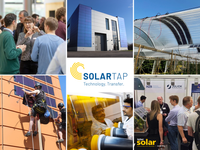
What's new in the world of building-integrated photovoltaics?
Generally speaking, BIPV was (as expected) not a dominant topic at the trade show. Even though numerous suppliers advertise their BIPV products, these are often just colored modules. There weren’t many examples of concepts involving the true integration of PV modules into the building envelope (whether the roof or the facade). This makes the few—mostly European—manufacturers who are explicitly and expertly dedicated to this topic stand out even more.
It has been clear for a few years now: the variety of colored solutions has become a reality. At the same time, transmission losses caused by the colored functional layers continue to be gradually minimized.
Two fundamentally different approaches to improving the glare behavior of solar modules are being pursued in practice: solutions already integrated directly into the module design, or anti-glare films that are applied retroactively to any module.
As is the case throughout the industry, silicon-based PV clearly dominates the BIPV market. As a result, colored modules with power outputs well over 200 W/m² have now become the industry standard. The alternative, “organic PV”—which offers lower power output but greater flexibility in terms of shape and transparency—remains on the market and now achieves approximately 70 W/m² on full-surface, semi transparent window areas. Furthermore, the ability of OPV to provide transparency optimized for photosynthesis makes it a promising application for use in greenhouses—an area being specifically addressed by the SolarTAP network, among others.
Of course, this is just a brief glimpse of the trade show and by no means exhaustive. Surely, some of you will have taken away additional impressions. For the topic of BIPV, Intersolar is certainly an exciting trade show and a good source of insight into trends and the current state of the solar industry. A visit is therefore always worthwhile.
By the way, we hardly saw any architects at Intersolar—even though BIPV is primarily a topic of interest to the construction industry. In our experience, the best way to reach that audience is through their established trade shows and conferences. For BIPV providers, this means having to juggle two different events. So you can also meet us early next year at the Inolope CX Architecture Congress in Dortmund.